Ukázka zaokrouhlení DPH
Jak finalize() opraví odchylky při zaokrouhlování DPH na úrovni jednotlivých položek.
fakturace DPH zaokrouhlování
Fakturace energií koncovým zákazníkům s řadou regulovaných položek a povinností vypočítávat průměrné náklady na dodanou energii není vůbec jednoduchá záležitost. V již rozpracovaném projektu, ke kterému jsem se připojil, byly výpočty rozházené po různých místech ad-hoc (model spotřeby, model faktury, šablona faktury) a slátané horkou jehlou. Když přišla potřeba posílat faktury automaticky do účetního software (Abra Flexibee) a ten některé faktury odmítal přijmout, neboť vypočtená DPH z jednotlivých položek neseděla na DPH za celkovou částku, byl potřeba rázný zásah.
K tomu jsem si vysnil nástroj, který by mi umožnil naházet všechny fakturované položky na jednu hromadu, spočítat DPH za celou fakturu a DPH za jednotlivé položky pak zkorigovat tak, jak jsem vyčetl z účetní příručky, a potom mi zase umožnil s pomocí štítků a filtrovacího systému položky z té hromady vyjmout a vypsat je v patřičných oddílech faktury a jednoduše je sčítat.
A tak jsem takový nástroj vyrobil.
require 'bigdecimal'
require 'bigdecimal/util'
require 'set'

class InvoiceCalculator
  # Represents an item on an invoice.
  class Item
    attr_reader :description, :tags, :vat_rate, :unit_price, :unit_price_with_vat, :count, :unit, :extras, :total, :vat, :total_with_vat, :currency, :precision

    # Arguments:
    # `description` - text description of item
    # `vat_rate` - in percents (required)
    # `count` - used to compute total from unit price, defaults to 1
    # `unit` - for display only
    # `tags` - array of tags or string of tags separated with space, used for item filtering
    # `extras` - arbitrary information attached to the item
    # `billed` - if false, item is for show only, not counted towards totals, defaults to true
    # `currency` - currency code (required)
    # `precision` - computed values will be rounded to this many decimal places, defaults to 2
    #
    # Price must be supplied either as:
    # (`unit_price` and/or `unit_price_with_vat` and `count` (defaults to 1)
    # or
    # (`total` and/or `total_with_vat`)
    #
    # If price is specified with VAT, item will be marked as total_with_vat_locked?
    # If price is specified without VAT, item will be marked as total_locked?
    # When both are locked, item cannot be corrected in `finalize`
    #
    # All numbers must be supplied as Integer or BigDecimal
    def initialize(description: nil, vat_rate:, unit_price: nil, unit_price_with_vat: nil, total_price: nil, total_price_with_vat: nil, count: 1, unit: nil, tags: [], extras: {}, billed: true, currency: , precision: 2)
      tags = tags.split(" ") if tags.is_a?(String)

      @description = description
      @tags = tags.is_a?(Array) ? tags : tags.split(" ")
      @extras = extras
      @unit = unit
      @billed = billed
      @precision = precision

      @vat_rate = ensure_precision!(vat_rate)
      @unit_price = ensure_precision(unit_price)
      @unit_price_with_vat = ensure_precision(unit_price_with_vat)
      @total = ensure_precision(total_price)
      @total_with_vat = ensure_precision(total_price_with_vat)
      @total_unlocked = true
      @total_with_vat_unlocked = true
      @currency = currency

      raise ArgumentError, "unit_price, unit_price_with_vat, total_price or total_price_with_vat is required" if @unit_price.nil? and @unit_price_with_vat.nil? and @total.nil? and @total_with_vat.nil?
      raise ArgumentError, "currency is required" if @currency.nil?

      @count = ensure_precision!(count)

      @total ||= (@unit_price * @count).round(precision) if @unit_price
      @total_unlocked = false if @total

      @total_with_vat ||= (@unit_price_with_vat * @count).round(precision) if @unit_price_with_vat
      @total_with_vat_unlocked = false if @total_with_vat

      # Derive the missing side(s)
      if @total && @total_with_vat
        @vat = @total_with_vat - @total
      elsif @total
        @vat = (@total * (@vat_rate / 100)).round(precision)
        @total_with_vat = @total + @vat
      elsif @total_with_vat
        @vat = (@total_with_vat * (@vat_rate / (@vat_rate + 100))).round(precision)
        @total = @total_with_vat - @vat
      else
        raise "This should have never happened."
      end
    end

    # BigDecimal is required throughout to avoid floating-point drift in calculations.
    def ensure_precision!(num)
      raise ArgumentError, "Integer or BigDecimal required as input to InvoiceCalculator" unless num.is_a?(Integer) || num.is_a?(BigDecimal)
      num.to_d
    end

    def ensure_precision(num)
      num && ensure_precision!(num)
    end

    def total_unlocked?
      @total_unlocked
    end

    def total_with_vat_unlocked?
      @total_with_vat_unlocked
    end

    def billed?
      @billed
    end

    # Shifts `delta` between vat and the unlocked total so the sum stays constant.
    # Raises if the adjustment would flip the sign of either field (sanity check).
    def apply_vat_delta(delta)
      if total_unlocked?
        @vat += delta
        @total -= delta
        raise "VAT gone mental and changed its sign" if @vat * @total < 0
      elsif total_with_vat_unlocked?
        @vat += delta
        @total_with_vat += delta
        raise "VAT gone mental and changed its sign" if @vat * @total < 0
      else
        raise "Cannot apply_vat_delta to locked item."
      end
    end

    # friendly output for debugging
    def to_s
      "  #<Item: #{description} #{vat_rate}%: #{unit_price} x #{count}: total=#{total} vat=#{vat} total_with_vat=#{total_with_vat} currency=#{currency} ##{tags}#{billed? ? "" : " NOT BILLED" }>"
    end

    # adds other item to self, keeps description, tags and extras of the first argument
    def +(other)
      raise ArgumentError("Incompatible items #{self}, #{other}") unless vat_rate == other.vat_rate && unit == other.unit && unit_price == other.unit_price && unit_price_with_vat == other.unit_price_with_vat && billed? == other.billed? && currency == other.currency

      self.class.new(
          description: description,
          vat_rate: vat_rate,
          unit: unit,
          unit_price: unit_price,
          unit_price_with_vat: unit_price_with_vat,
          total_price: total + other.total,
          total_price_with_vat: total_with_vat + other.total_with_vat,
          count: count + other.count,
          billed: billed?,
          tags: tags.dup,
          extras: extras.dup,
          currency: currency
      )
    end
  end

  # A container for holding sums generated by `sum` method on an Invoice.
  # Holds either overall aggregate (@sum) and per-VAT-rate aggregates (@subs) accessible through [] operator,
  # or just one subaggregate (@subs will be empty).
  #
  # This way both types of sums share the same interface.
  #
  # Example:
  # invoice_calculator.sum      => `Sum` - overall sum with per-VAT-rate aggregates
  # invoice_calculator.sum[21]  => `Sum` - sum of items with given VAT rate
  class Sum
    # `sums` Hash<vat_rate, hash_with_summed_attributes>
    # nil key holds the overall aggregate and will be stored in @sum
    # aggregates for individual VAT rates (if present) will be stored in @subs
    #
    # See: `InvoiceCalculator#sum`
    def initialize(currency, sums)
      @sum = {}
      @subs = {}
      @currency = currency

      sums.each do |k, v|
        if k.nil?
          @sum = v
        else
          @subs[k.to_d] = self.class.new(currency, nil => v)
        end
      end
    end

    # delegate to @sum
    def values_at(*keys)
      @sum.values_at(*keys)
    end

    # Returns the sub-sum for a specific VAT rate, or a zero-filled placeholder when
    # no items with that rate exist (avoids nil checks in templates).
    def [](vat_rate)
      @subs[vat_rate.to_d] || Sum.new(@currency, nil => {currency: @currency, total: 0.to_d, vat: 0.to_d, total_with_vat: 0.to_d, vat_rate: vat_rate.to_d, count: 0})
    end

    def to_h
      @sum
    end

    # Iterates per VAT rate when sub-sums exist, or yields self for a flat sum.
    # Skips zero-total sums to avoid blank rows in invoice templates.
    def each_vat_rate
      if @subs.any?
        @subs.each do |_, sum|
          yield sum
        end
      else
        yield self unless self.total.zero?
      end
    end

    # Delegate common aggregate field accessors directly to the underlying hash.
    [:total, :vat, :total_with_vat, :unit, :vat_rate, :count, :extras].each do |method|
      define_method(method) do
        @sum[method]
      end
    end

    # friendly output for debugging
    def to_s
      "  #<Sum #{@currency} #{@sum.except(:extras).collect {|k, v| "#{k}=#{v}"}.join(" ")}" + (@subs.any? ? "\n" + @subs.collect {|_, s| "  #{s}"}.join("\n") + "\n  " : "") + ">"
    end
  end

  # InvoiceCalculator itself starts here
  attr_reader :items, :vat_summary, :totals, :currency, :precision

  def initialize(currency: 'CZK', precision: 2)
    @items = []
    @totals = nil
    @currency = currency
    @precision = precision
  end

  # Convenience shortcuts that delegate to the overall sum.
  def total
    totals&.total
  end

  def vat
    totals&.vat
  end

  def total_with_vat
    totals&.total_with_vat
  end

  # Adding an item invalidates the cached totals so they are recalculated on next access.
  # See: InvoiceCalculator::Item for argument descriptions
  def add_item(description: nil, vat_rate:, unit_price: nil, unit_price_with_vat: nil, total_price: nil, total_price_with_vat: nil, count: 1, unit: nil, tags: [], extras: {}, billed: true, currency: @currency, precision: @precision)
    @totals = nil
    @items << Item.new(description: description, vat_rate: vat_rate, unit_price: unit_price, unit_price_with_vat: unit_price_with_vat, total_price: total_price, total_price_with_vat: total_price_with_vat, count: count, unit: unit, tags: tags, extras: extras, billed: billed, currency: currency, precision: precision)
  end

  # Updates items for each vat_rate in such way so
  # sum(:total) + sum(:vat) = sum(:total_with_vat)
  # AND
  # sum(:vat) = sum(:total) * (vat_rate / 100)
  # OR (in case that all items have total_with_vat_locked?)
  # sum(:vat) = sum(:total_with_vat) * ( vat_rate / (vat_rate + 100) )
  #
  # `max_delta_per_item` - finalize will fail if correction for any item gets higher than this to satisfy previous conditions.
  #                        That may happen if there are very bad locked items and not enough unlocked ones.
  #                        Defaults to 2 of least significant digit.
  def finalize(max_delta_per_item: 2 * "0.1".to_d ** precision)
    # categorizes items by VAT rate
    categories = Hash.new {|h, k| h[k] = {vat_rate: k, total: 0, total_with_vat: 0, vat: 0, items: []}}

    items.select(&:billed?).each do |item|
      cat = categories[item.vat_rate]
      cat[:items] << item
      cat[:total] += item.total
      cat[:vat] += item.vat
      cat[:total_with_vat] += item.total_with_vat
    end

    # corrects each category
    categories.values.each do |cat|
      if items.any?(&:total_unlocked?)
        k = (cat[:vat_rate] / (cat[:vat_rate] + 100))
        precise_vat = (cat[:total_with_vat] * k).round(precision)
        tweakables = cat[:items].select(&:total_unlocked?)

        # difference between VAT from individual items vs. VAT calculated from total
        delta = precise_vat - cat[:vat]

        # sets corrected total value
        cat[:vat] += delta
        cat[:total] -= delta

      elsif items.any?(&:total_with_vat_unlocked?)
        precise_vat = (cat[:total] * (cat[:vat_rate] / 100)).round(precision)

        tweakables = cat[:items].select(&:total_with_vat_unlocked?)

        # difference between VAT from individual items vs. VAT calculated from total
        delta = precise_vat - cat[:vat]

        # sets correct total value
        cat[:vat] += delta
        cat[:total_with_vat] += delta
      else
        # nothing to tweak...
        next
      end

      if delta != 0
        # Distribute the delta proportionally by each item's VAT share.
        # Items with zero VAT are excluded as they can't absorb any portion.
        tweakables.select! {|t| t.vat != 0}
        total_vat = tweakables.sum {|t| t.vat.abs}

        raise "Delta too big in `finalize`. Delta #{delta}, tweakables #{tweakables.size}" if delta.abs > max_delta_per_item * tweakables.size

        # Iterates over tweakables and applies delta whenever remaining error weighted by tweakable.vat
        # is bigger than precision step.
        while tweakables.any?
          specific_delta = delta / total_vat

          tweakable = tweakables.shift

          total_vat -= tweakable.vat.abs
          tweak = (specific_delta * tweakable.vat.abs).round(precision)
          tweakable.apply_vat_delta(tweak)
          delta -= tweak
        end
      end
    end

    @totals = nil
  end

  # Filters items by tag inclusion/exclusion. Tags can be passed as separate arguments
  # or as a single space-separated string.
  #
  # All `tags` must match for item to be accepted.
  # Any of `except` matching will cause item to be rejected.
  def filter_items(*tags, except: [])
    tags = tags.first.split(" ") if tags.size == 1 && tags.first.is_a?(String)
    except = except.split(" ") if except.is_a?(String)

    items.select {|i| tags.all? {|t| i.tags.include?(t)} && except.none? {|t| i.tags.include?(t)}}
  end

  # Aggregates billed items matching the tag filter into a Sum. Each item is counted
  # twice — once in the overall nil-keyed aggregate and once in its VAT-rate bucket —
  # so the Sum can answer both flat and per-rate queries without a second pass.
  # unit and count are only exposed when all matched items share the same unit.
  def sum(*tags, except: [])
    sums = Hash.new do |h, k|
      h[k] = {
          currency: @currency,
          total: 0,
          vat: 0,
          total_with_vat: 0,
          unit: Set.new,
          vat_rate: Set.new,
          count: 0,
          extras: [],
      }
    end

    sums[nil] # initialize for case of empty filter

    filter_items(*tags, except: except).select(&:billed?).each do |item|
      if item.currency != @currency
        raise "Item has wrong currency #{item.currency}"
      end

      # update aggregates for overall sum and for item.vat_rate
      [nil, item.vat_rate].each do |key|
        s = sums[key]
        s[:total] += item.total
        s[:vat] += item.vat
        s[:total_with_vat] += item.total_with_vat
        s[:count] += item.count
        s[:unit].add(item.unit)
        s[:vat_rate].add(item.vat_rate)
        s[:extras] << item.extras
      end
    end

    sums.each do |k, s|
      if s[:unit].size == 1
        unit, count = s[:unit].first, s[:count]
      else
        unit, count = nil, nil
      end

      s.merge!(
          unit: unit,
          count: count,
          vat_rate: s[:vat_rate].size == 1 ? s[:vat_rate].first : nil
      )
    end

    Sum.new(@currency, sums)
  end

  # Block form of sum — yields the Sum so callers can use it in an ERB assign-and-render pattern.
  def with_sum(*tags, except: [], &block)
    yield sum(*tags, except: except)
  end

  # friendly output for debugging
  def to_s
    "#<InvoiceCalculator(#{@currency}):\n#{items.collect(&:to_s).join("\n")}\n#{totals}\n>"
  end

  # cached sum for the whole invoice
  def totals
    @totals ||= sum
  end

  # Returns a new InvoiceCalculator with all items converted to target_currency.
  # `rates` is a hash of "FROM:TO" or "TO:FROM" string keys to BigDecimal multipliers;
  # (price_czk = price_eur * "EUR:CZK" OR price_czk = price_eur / "CZK:EUR")
  # the inverse rate is applied automatically when only the reverse pair is supplied.
  # Locked totals are preserved as locked in the new calculator so finalize behaviour
  # remains consistent after conversion.
  def convert_to(target_currency, rates, precision: 2)
    out = InvoiceCalculator.new(currency: target_currency, precision: precision)

    items.each do |item|
      if item.currency == target_currency
        rate = 1.to_d
      elsif rate = rates["#{item.currency}:#{target_currency}"]
        raise ArgumentError, "Integer or BigDecimal required as input to InvoiceCalculator" unless rate.is_a?(Integer) || rate.is_a?(BigDecimal)
      elsif rate = rates["#{target_currency}:#{item.currency}"]
        raise ArgumentError, "Integer or BigDecimal required as input to InvoiceCalculator" unless rate.is_a?(Integer) || rate.is_a?(BigDecimal)
        rate = 1.to_d / rate
      else
        raise ArgumentError, "Missing conversion rate for #{target_currency}:#{item.currency}"
      end

      rate = rate.to_d

      out.add_item(
          description: item.description,
          tags: item.tags,
          vat_rate: item.vat_rate,
          unit_price: item.unit_price && (item.unit_price * rate).round(precision),
          unit_price_with_vat: item.unit_price_with_vat && (item.unit_price_with_vat * rate).round(precision),
          count: item.count,
          unit: item.unit,
          extras: item.extras,
          currency: target_currency,
          precision: precision,
          total_price: item.total_unlocked? ? nil : (item.total * rate).round(precision),
          total_price_with_vat: item.total_with_vat_unlocked? ? nil : (item.total_with_vat * rate).round(precision),
          billed: item.billed?
        )
    end

    out
  end
end
Při počítání DPH po položkách snadno vznikne rozdíl, kdy součet DPH vypočtené pro jednotlivé položky nesedí s DPH vypočtené z celého základu daně za fakturu.
items = [
  { price: 1.07, vat: (1.07 * 0.21).round(2) },  # 0.22
  { price: 1.07, vat: (1.07 * 0.21).round(2) },  # 0.22
  { price: 1.07, vat: (1.07 * 0.21).round(2) },  # 0.22
]

total     = items.sum { |i| i[:price] }          # 3.21
sum_vat   = items.sum { |i| i[:vat] }            # 0.66
# Správná DPH z celku: (3.21 * 0.21).round(2)    # 0.67
# Odchylka: 0.01 Kč - faktura nesedí!
InvoiceCalculator tento problém řeší metodou finalize: spočítá přesnou DPH z celkového součtu (pro každou sazbu) a odchylku rozdělí proporcionálně mezi položky:
ic = InvoiceCalculator.new(currency: 'CZK')
ic.add_item(unit_price: "1.07".to_d, vat_rate: 21, currency: 'CZK')
ic.add_item(unit_price: "1.07".to_d, vat_rate: 21, currency: 'CZK')
ic.add_item(unit_price: "1.07".to_d, vat_rate: 21, currency: 'CZK')
ic.finalize

ic.items.map(&:vat)           # [0.22, 0.23, 0.22] - odchylka rozložena
ic.items.sum(&:vat)           # 0.67 - sedí s DPH z celku
ic.sum.vat                    # 0.67
Metoda funguje i obráceně — pokud jsou zadány ceny s DPH (unit_price_with_vat), opraví místo DPH základ daně.
Při opravách (dobropis) potřebujeme zachovat původní hodnotu některých položek. Kalkulátor rozlišuje dva typy „zámku":
total_unlocked? — základ DPH lze upravit (byla zadána cena včetně DPH)total_with_vat_unlocked? — cenu s DPH lze upravit (byla zadána cena bez DPH)false — položka je zcela zamčena (zadána cena bez i včetně DPH)finalize upravuje pouze odemčené položky a nikdy nepřesáhne konfigurovaný max_delta_per_item.
Jak finalize() opraví odchylky při zaokrouhlování DPH na úrovni jednotlivých položek.
Faktura musí zobrazovat různé součty např.: součet za jedno odměrné místo, součet nákladů za 1 MWh, součet nákladů za měsíc, platba za samotnou energii, platba za distribuci. Z toho důvodu si model faktury držel různé druhy položek v různých seznamech a speciálních strukturách na jedno použití. To vše muselo být předpočítáno na různých místech a množství lokálních a instančních proměnných s nejasným významem rostlo. To vše bylo nahrazeno štítky např. "commodity vt el_om_26" znamená, že jde o platbu za dodanou el. energii ve vysokém tarifu pro odběrné místo s ID 26 (proměnná om_tag).
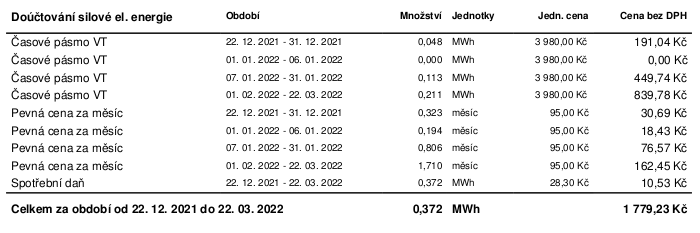
Výpis takovéto sekce pak v šabloně vypadal takto
<% start, stop, qty, total = nil, nil, 0, 0 %>
<table class="invoice_summary" width="95%" style="margin:20px 0">
  <tr style="border-bottom:1px solid black;margin:5px 0">
    <th>Doúčtování silové el. energie</th>
    <% if items.size > 0 %>
      <th style="font-size: 80%">Období</th>
    <% end %>
    <th class="num" style="font-size: 80%">Množství</th>
    <th style="font-size: 80%">Jednotky</th>
    <th class="num" style="font-size: 80%">Jedn. cena</th>
    <th class="num" style="font-size: 80%">Cena bez DPH</th>
  </tr>

  <%# VT %>
  <% items.each do |item| %>
    <tr>
      <% start = item[:start] if !start || start > item[:start] %>
      <% stop = item[:stop] if !stop || stop < item[:stop] %>
      <% qty += item[:qty] %>
      <% total += item[:total_vt].round(2) %>
      <td>Časové pásmo VT</td>
      <% if items.size > 0 %>
        <td style="font-size: 80%"><%= "#{item[:start]} - #{item[:stop]}" %></td>
      <% end %>
      <td class="num" style="font-size: 80%"><%= num3(item[:qty_vt].to_f / 1000) %></td>
      <td style="font-size: 80%">MWh</td>
      <td class='num' style="font-size: 80%"><%= num2 item[:price_vt] %> Kč</td>
      <td class="num"><%= num2 item[:total_vt] %> Kč</td>
    </tr>
  <% end %>

  <%# NT %>
  <% items.each do |item| %>
    <% next if item[:qty_nt].to_f == 0 %>
    <tr>
      <% total += item[:total_nt].round(2) %>
      <td>Časové pásmo NT</td>
      <% if items.size > 0 %>
        <td style="font-size: 80%"><%= "#{item[:start]} - #{item[:stop]}" %></td>
      <% end %>
      <td class="num" style="font-size: 80%"><%= num3(item[:qty_nt].to_f / 1000) %></td>
      <td style="font-size: 80%">MWh</td>
      <td class='num' style="font-size: 80%"><%= num2 item[:price_nt] %> Kč</td>
      <td class="num"><%= num2 item[:total_nt] %> Kč</td>
    </tr>
  <% end %>

  <%# monthly %>
  <% items.each do |item| %>
    <% next if item[:total_month].to_f == 0 %>
    <tr>
      <% total += item[:total_month].round(2) %>
      <td>Pevná cena za měsíc</td>
      <% if items.size > 0 %>
        <td style="font-size: 80%"><%= "#{item[:start]} - #{item[:stop]}" %></td>
      <% end %>
      <td class="num" style="font-size: 80%"><%= num3 item[:months] %></td>
      <td style="font-size: 80%">měsíc</td>
      <td class='num' style="font-size: 80%"><%= num2 item[:price_month] %> Kč</td>
      <td class="num"><%= num2 item[:total_month] %> Kč</td>
    </tr>
  <% end %>

  <%# tax %>
  <tr>
    <% total += qty * Invoice::TAX_ELECTRICITY / 1000 %>
    <td>Spotřební daň</td>
    <% if items.size > 0 %>
      <td></td>
    <% end %>
    <td class="num" style="font-size: 80%"><%= num3 qty.to_f / 1000 %></td>
    <td style="font-size: 80%">MWh</td>
    <td class="num" style="font-size: 80%"><%= num2 Invoice::TAX_ELECTRICITY %> Kč</td>
    <td class="num"><%= num2 qty * Invoice::TAX_ELECTRICITY / 1000 %> Kč</td>
  </tr>

  <%# total %>
  <tr style="border-top:1px solid black;margin:5px 0">
    <th <%= 'colspan="2"'.html_safe if items.size > 0 %>>Celkem za období od <%= start %> do <%= stop %></th>
    <th class="num"><%= num3 qty.to_f / 1000 %></th>
    <th>MWh</th>
    <th></th>
    <th class="num"><%= num2 total %> Kč</th>
  </tr>

  <% om_total += total %>
</table>
Po zavedení `InvoiceCalculator` takto
<table class="invoice_summary" width="95%" style="margin:20px 0">
  <tr style="border-bottom:1px solid black;margin:5px 0">
    <th>Doúčtování silové el. energie</th>

    <th style="font-size: 80%">Období</th>

    <th class="num" style="font-size: 80%">Množství</th>
    <th style="font-size: 80%">Jednotky</th>
    <th class="num" style="font-size: 80%">Jedn. cena</th>
    <th class="num" style="font-size: 80%">Cena bez DPH</th>
  </tr>

  <%# VT, NT, monthly %>
  <% ["vt", "nt", "month"].each do |tag| %>
    <% calc.filter_items("commodity", om_tag, tag).each do |item| %>
      <tr>
        <td><%= item.description %></td>
        <td style="font-size: 80%"><%= "#{item.extras[:start]} - #{item.extras[:stop]}" %></td>
        <td class="num" style="font-size: 80%"><%= num3(item.count) %></td>
        <td style="font-size: 80%"><%= item.unit %></td>
        <td class='num' style="font-size: 80%"><%= num2 item.unit_price %> Kč</td>
        <td class="num"><%= num2 item.total %> Kč</td>
      </tr>
    <% end %>
  <% end %>


  <%# tax %>
  <% if (tax_items = calc.filter_items("commodity", om_tag, "tax")).any? %>
    <tr>
      <td><%= tax_items.first.description %></td>
      <td style="font-size: 80%"></td>
      <td class="num" style="font-size: 80%"><%= num3(tax_items.sum(&:count)) %></td>
      <td style="font-size: 80%"><%= tax_items.first.unit %></td>
      <td class='num' style="font-size: 80%"><%= num2 tax_items.first.unit_price %> Kč</td>
      <td class="num"><%= num2 tax_items.sum(&:total) %> Kč</td>
    </tr>
  <% end %>


 <%# total %>
 <tr style="border-top:1px solid black;margin:5px 0">
    <th colspan="2">Celkem za období od <%= start %> do <%= stop %></th>
    <% calc.with_sum("commodity", om_tag, except: "tax month") do |s| %>
      <th class="num"><%= num3 s.count %></th>
      <th><%= s.unit %></th>
    <% end %>
    <th></th>
    <th class="num"><%= num2 calc.sum("commodity", om_tag).total %> Kč</th>
  </tr>
</table>
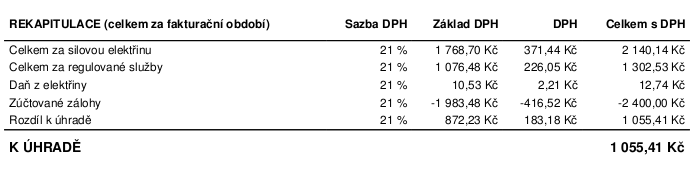
S předpočítanými hodnotami z modelu @invoice
<table class="invoice_summary" width="95%" style="margin:20px 0">
<tr style="border-bottom:1px solid black;margin:5px 0">
<th>REKAPITULACE (celkem za fakturační období)</th>
<th>Sazba DPH</th>
<th>Základ DPH (Kč)</th>
<th>DPH (Kč)</th>
<th>Celkem s DPH (Kč)</th>
</tr>
<tr>
<td>Celkem za silovou elektřinu</td>
<td><%= @invoice.vat_rate %>%</td>
<td class="num"><%= num2 @invoice.energy %></td>
<td class="num"><%= num2 @invoice.energy_vat %></td>
<td class="num"><%= num2 @invoice.energy_with_vat %></td>
</tr>
<tr>
<td>Celkem za regulované služby</td>
<td><%= @invoice.vat_rate %>%</td>
<td class="num"><%= num2 @invoice.total_delivery %></td>
<td class="num"><%= num2 @invoice.distribution_vat %></td>
<td class="num"><%= num2 @invoice.distribution_with_vat %></td>
</tr>
<%# other / irregular payments %>
<% if @invoice.other %>
<% opv = @invoice.other_per_vat_rate %>
<% opv.each do |vat, items| %>
<tr>
<td>Celkem za ostatní služby</td>
<td><%= vat %>%</td>
<td class="num"><%= num2(sum = items.sum{|x| x[:value]}) %></td>
<td class="num"><%= num2(vatsum = sum * vat / 100) %></td>
<td class="num"><%= num2(sum + vatsum) %></td>
<%# TODO this isn't counted in K ÚHRADĚ %>
</tr>
<% end %>
<% end %>
<%# penalizations %>
<% if @invoice.penalties.any? %>
<tr>
<td>Penalizace pozdních plateb</td>
<td><%= 0 %>%</td>
<td class="num"><%= num2 @invoice.penalty_total %></td>
<td class="num"><%= num2 0 %></td>
<td class="num"><%= num2 @invoice.penalty_total %></td>
</tr>
<% end %>
<tr>
<td>Daň z elektřiny</td>
<td><%= @invoice.vat_rate %>%</td>
<td class="num"><%= num2 @invoice.tax %></td>
<td class="num"><%= num2 @invoice.tax_vat %></td>
<td class="num"><%= num2 @invoice.tax_with_vat %></td>
</tr>
<% if @invoice.advance != 0 %>
<tr>
<td>Zúčtované zálohy</td>
<td><%= @invoice.vat_rate %>%</td>
<td class="num"><%= num2 -@invoice.advance %></td>
<td class="num"><%= num2 -@invoice.advance_vat %></td>
<td class="num"><%= num2 -@invoice.advance_with_vat %></td>
</tr>
<% end %>
<tr>
<td>Rozdíl k úhradě</td>
<td><%= @invoice.vat_rate %>%</td>
<td class="num"><%= num2 @invoice.outstanding %></td>
<td class="num"><%= num2 @invoice.outstanding_vat %></td>
<td class="num"><%= num2 @invoice.outstanding_with_vat %></td>
</tr>
<tr>
<td>Zaokrouhlení</td>
<td> </td>
<td> </td>
<td> </td>
<td class="num"><%= num2 @invoice.rounding %></td>
</tr>
<tr style="border-top:1px solid black;margin:5px 0">
<th>K ÚHRADĚ</th>
<th></th>
<th></th>
<th></th>
<th class="num"><b style="font-size: 120%"><%= num0 @invoice.to_pay %> Kč</b></th>
</tr>
</table>
S použitím funkce sumy a filtrováním podle štítků
<%
calc = @invoice.calculator
summary = [
["Celkem za silovou elektřinu", calc.sum("commodity", except: "tax")],
["Celkem za regulované služby", calc.sum("delivery")],
["Celkem za ostatní služby", calc.sum("other")],
["Penalizace pozdních plateb", calc.sum("penalty")],
["Daň z elektřiny", calc.sum("tax")],
["Zúčtované zálohy", calc.sum("advance")],
]
%>
<table class="invoice_summary" width="95%" style="margin:20px 0">
<tr style="border-bottom:1px solid black;margin:5px 0">
<th>REKAPITULACE (celkem za fakturační období)</th>
<th>Sazba DPH</th>
<th>Základ DPH (Kč)</th>
<th>DPH (Kč)</th>
<th>Celkem s DPH (Kč)</th>
</tr>
<%# za všechny sekce vyjmenované výše %>
<% summary.each do |title, sum| %>
<% sum.each_vat_rate do |s| %>
<tr>
<td><%= title %></td>
<td><%= num s.vat_rate %>%</td>
<td class="num"><%= num2 s.total %></td>
<td class="num"><%= num2 s.vat %></td>
<td class="num"><%= num2 s.total_with_vat %></td>
</tr>
<% end %>
<% end %>
<% calc.with_sum(except: "rounding") do |s| %>
<tr>
<td>Rozdíl k úhradě</td>
<td><%= s.vat_rate &&num(s.vat_rate) + "%" %></td>
<td class="num"><%= num2 s.total %></td>
<td class="num"><%= num2 s.vat %></td>
<td class="num"><%= num2 s.total_with_vat %></td>
</tr>
<% end %>
<tr>
<td>Zaokrouhlení</td>
<td> </td>
<td> </td>
<td> </td>
<td class="num"><%= num2 calc.sum("rounding").total_with_vat %></td>
</tr>
<tr style="border-top:1px solid black;margin:5px 0">
<th>K ÚHRADĚ</th>
<th></th>
<th></th>
<th></th>
<th class="num"><b style="font-size: 120%"><%= num calc.total_with_vat %> Kč</b></th>
</tr>
</table>
Sčítání a filtrování položek faktury podle štítků — základ pro generování dílčích součtů.
Později přibyla možnost pro zákazníky zasmluvnit cenu komodity v eurech, nebo možnost nechat si vystavit fakturu v eurech. K tomu bylo potřeba přidat funkci přepočtu měn. Každá položka proto nese informaci o měně, v níž je cena vedena a položky, které nesouhlasí s měnou faktury jsou při finalizaci přepočteny nastaveným kurzem
Zákazník má zasmluvněnou cenu energie v EUR, regulovaná složka zůstává v CZK. Máte na výběr fakturaci v CZK, EUR nebo INV (neznámý kurz způsobí chybu).
Implementace má pochopitelně i kompletní unit testy